Lemon Sharks and Sea Turtles on Sal – the Season, the Law and the Question to Ask
Updated September 24, 2026 · 7 min read
Two wildlife encounters dominate the booking pages on Sal, and they could hardly be less alike. One happens in knee-deep water in the middle of the afternoon and takes about forty minutes. The other happens in the dark, is regulated by law, and only exists for four months of the year.
Both are worth doing. Neither is quite what the photographs imply.
Turtles: four months, and a rule with teeth
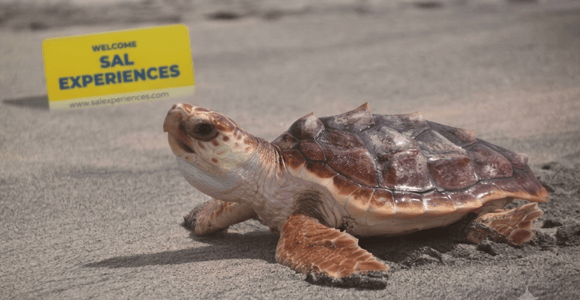
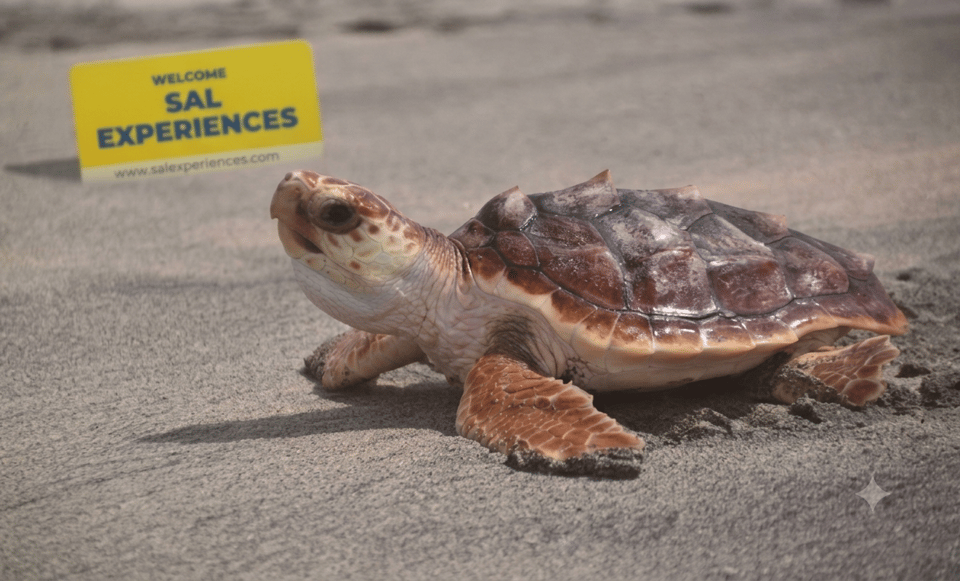
Cape Verde is one of the most important loggerhead nesting sites on earth – the archipelago holds roughly 15 % of the world’s nesting population of Caretta caretta, which makes it the third-largest site anywhere. The females come ashore on Sal’s beaches to lay. The nesting season runs from June to October, and tours are bookable in the four months July to October. Hatchlings emerge later, from August into December.
Now the part that matters before you book anything. It is illegal to go to a beach at night to observe nesting turtles without a guide during the nesting season, which runs from June to October. That is not an operator’s house rule or a conservation charity’s preference – it is the law, and it exists because a disturbed female will turn around and go back into the sea without laying.
So the choice is not “guided tour or walk down myself”. It is “guided tour or nothing”, and the guide should be a government-certified one.
The rules on the beach follow from the same logic, and a good guide will state them before you leave the vehicle:
- All lights off. Flash photography, torches and white light of any kind are prohibited. The tours that photograph anything use infrared.
- Never put light in her face.
- Never touch the turtle.
- Only approach once she has started laying. A female that is still choosing her spot will abandon it.
- A maximum of ten people behind a nesting turtle.
The most-booked option is the sea turtle watching eco-tour with a native guide – €38, two hours, 598 reviews. It includes hotel pickup from Santa Maria, Espargos and Murdeira, a certified guide, and specialist infrared lighting so that there is something to photograph without breaking the first rule. The operator says its success rate over the past five years has been 99 % and, correctly, that sightings still cannot be guaranteed. Nesting is not a performance with a start time.
Three things in the small print rule people out, and they are easy to miss: the tour is not suitable for children under three, not suitable for wheelchair users or guests with reduced mobility, and not suitable for anyone uncomfortable in dark outdoor places. That last one is not a formality. You will be walking on soft sand, in the dark, without a torch.
Alternatives within the same season: a three-hour turtle watching experience from €30 with 492 reviews, or a nesting tour accompanied by a marine biologist, three hours from €40, which is the version to pick if you want the biology and not just the sighting. There are 20 turtle trips in total, from €28.
If you are on Sal between November and June, none of this is available, and any offer that suggests otherwise is selling you something else. That is the same half of the year when the trade winds blow, which is worth knowing when you plan the trip rather than when you arrive.
Sharks: shallow, year-round, and one uncomfortable question
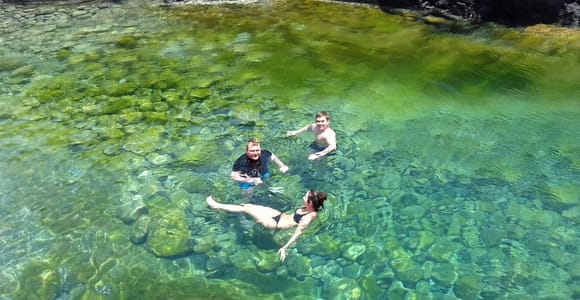
Shark Bay, on the east coast a short drive from Santa Maria, is a natural nursery for lemon sharks. What lives there is juveniles: young animals that spend several years in shallow, sandy water where larger predators cannot follow them, before moving out to deeper sea as adults.
That is the whole appeal and the whole safety argument in one. The water is rarely deeper than your waist, the sharks are small, and they are not interested in you. You put on water shoes, wade in, and they pass a couple of metres away.
The lemon shark watching eco-tour from Santa Maria runs two hours from €29 and has 471 reviews. Water shoes are provided – wear them, the bottom is rock as well as sand – and the actual time at the bay is around forty minutes; the rest is the drive. Pickup covers Santa Maria, Espargos and Murdeira. It is listed as unsuitable for wheelchair users and guests with reduced mobility, and anyone who has been drinking will not be taken into the water.
Here is the question worth asking, and it is the reason this section exists. Some guides at Shark Bay bait the water – fish scraps thrown in to bring the animals close for photographs. The practice turns up repeatedly in visitor accounts. Operators who take the conservation side seriously put nothing in the water at all: these are wild juveniles feeding naturally in a nursery, and teaching them to associate people with food is not a neutral act.
The listing for the tour above states that its guides follow strict animal welfare standards. Ask what that means in practice, specifically whether anything goes into the water. It is a fair question, it takes ten seconds, and a good operator will be pleased you asked.
Doing both in one trip
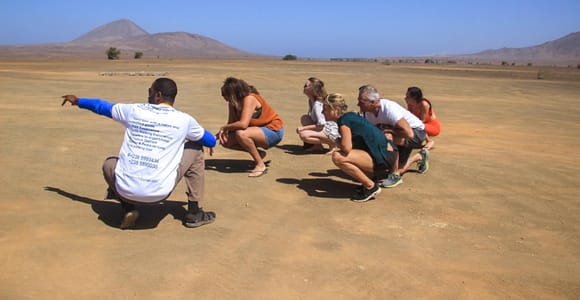
If you are here in the turtle season, the sensible shape is sharks in the afternoon and turtles after dark on a different day – the turtle tours run late and you will not want a full day behind you. Outside the season, the sharks pair naturally with the island circuit, 55 tours from €27, since Shark Bay is a standard stop on the half-day and full-day routes anyway. Several of those also take in the salt lake and the Blue Eye for the same money.
And if you want to see a turtle in the water rather than on the sand, that is a different booking again: the snorkelling trips see them on the reef, out of season as well as in it, with the honest caveat that nobody can promise you one.